Corns, Calluses or Something Else?
A Simple Guide to Understanding Painful Hard Skin on Your Feet
"Ratna… is this a corn?"
It's probably one of the most common questions I'm asked in clinic.
A patient points to a painful lump on their foot and says,
"I've tried everything… is it a corn?"
Sometimes the answer is yes.
But surprisingly often...
It isn't.
Many different foot conditions can look surprisingly similar. Corns, calluses, verrucas, seed corns and even some inherited skin conditions can all appear as hard skin. To the untrained eye they can look almost identical, yet each has a different cause and may need a different treatment.
That's why getting the diagnosis right is so important.
The good news?
Most of the time, once we understand what's causing the problem, treatment becomes much more straightforward.
A Real Story From My Clinic
Not long ago, an elderly lady came to see me convinced she had a verruca.
She hadn't been swimming.
She hadn't used communal changing rooms.
She couldn't understand where she'd picked up the virus.
She'd already bought verruca treatments from the chemist and had spent several weeks applying them, becoming increasingly frustrated because nothing seemed to work.
After examining her foot, I smiled and said,
"I can see why you thought it was a verruca... but it's actually a corn."
Within minutes she understood why the treatment hadn't worked.
She wasn't treating the wrong verruca.
She was treating the wrong condition.
That consultation reminded me how confusing painful hard skin can be, and it's one of the reasons I wanted to write this guide.
So what actually is a corn?
Think of a corn like the core of an apple.
On the surface, it looks like a small patch of hard skin.
Underneath, however, is a tiny cone of hard skin that presses into the softer tissues every time you stand or walk.
That's why something so small can be surprisingly painful.
Corns usually develop over areas of repeated pressure or friction, such as:
The tops of the toes
The sides of the toes
Between the toes
Under the ball of the foot
Anywhere shoes repeatedly rub
Removing the hard skin often gives immediate relief.
However, if the pressure remains, the corn will usually return.
That's because the corn isn't the problem.
It's your body's response to the problem.
Most people think a corn is simply a corn, but there are several different types, including hard corns, soft corns, seed corns and neurovascular corns. Some inherited skin conditions, such as punctate palmoplantar keratoderma (PPPK), can even look very similar. Knowing the difference helps explain why some are only mildly uncomfortable while others can be extremely painful.
What about Callus?
Like corns, callus is caused by pressure. The difference is that it spreads over a wider area instead of forming a central core.
Not all corns are the same?
Just when you thought a corn was simply a corn… there are actually several different types. Understanding which one you have helps explain why treatments vary and why some are much more painful than others.
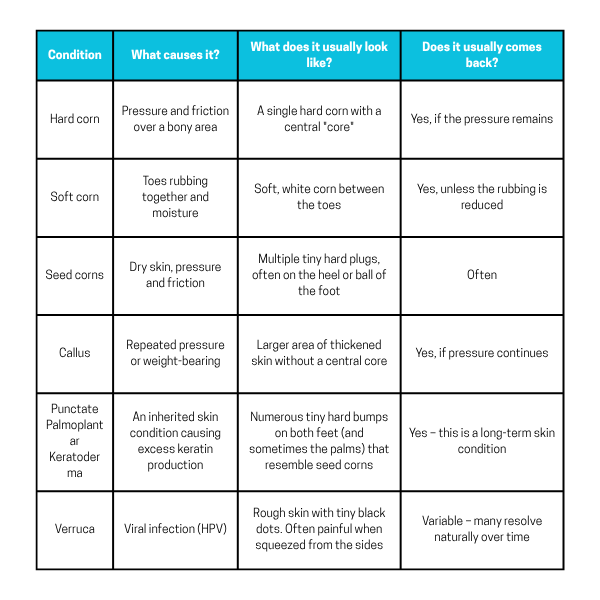
At A Glance: Corn, Callus or Something Else?
So if your "corn" doesn't behave like a typical corn, there's a good chance it's something else entirely. That's why getting the diagnosis right matters!
Why Do Corns and Calluses Develop?
This is probably the most important part of this guide.
Many people think corns and calluses simply "appear."
They don't.
They're nearly always your body's way of protecting itself.
Imagine spending an afternoon digging in the garden without gloves.
Or lifting weights for the first time.
A few weeks later you'll probably notice thicker skin on your hands.
Your feet behave in exactly the same way.
When one part of your foot is exposed to repeated pressure or rubbing, the skin produces extra keratin to protect itself.
Sometimes that extra skin spreads out and becomes a callus.
Sometimes it forms a small cone that presses into the skin, creating a corn.
So the important question isn't:
"How do I get rid of my corn?"
It's:
"Why did it develop in the first place?"
Once we answer that question, we have a much better chance of stopping it from coming back.
Where Does That Pressure Come From?
Pressure doesn't usually come from just one thing.
It's often a combination of several factors, including:
Shoes that are too tight, too loose or rub in certain areas
Bunions or prominent joints
Hammer toes or claw toes
The way you walk
Changes in your feet as you get older
Sports, work or hobbies that repeatedly load the same part of your foot
This is why two people can wear exactly the same pair of shoes and only one develops a corn.
Every foot is different.
Ratna's Real Clinic Story 👟
One of my patients, a yoga teacher, developed a painful corn shortly after buying the last pair of Adidas trainers in his size.
One shoe had been on display and had gradually stretched as hundreds of customers tried it on.
The other came brand new from the box.
Although they were technically the same size, they no longer fitted the same.
That tiny difference created just enough extra pressure to cause a painful corn.
💚 Ratna's Tip
If you're buying the last display pair of shoes, always try on both shoes and walk around in them.
If one feels tighter than the other, trust your feet, not the number printed inside the shoe.
[You can read my footwear blog here]
There are a few myths I hear almost every day:
• "Corns have roots."
• "It's probably a verruca."
• "It's just hard skin."
The truth is that corns don't have roots. They develop because of pressure, so unless that pressure changes, they're likely to come back
What People Try First…
And this is where things sometimes go wrong.
Corn plasters
Verruca treatments
Filing
Ignoring it
Corn plasters are a common one.
They contain acid, and when removed, they can take healthy skin with them, not just the corn.
I’ve seen more than a few wounds caused this way.
At that point, we’re no longer dealing with hard skin.
We’re dealing with damage.
So what is the Treatment?
It isn't simply about removing the hard skin.
First, we identify why it developed.
Then we carefully remove the corn or callus.
Finally, we reduce the pressure with footwear advice, padding, toe props or, where appropriate, orthoses.
That's the part that helps stop it coming back.
When Should You Come and See a Podiatrist?
It’s painful
It keeps coming back
You’re not sure what it is
Home treatment isn’t working
You’ve created a wound
You have conditions like diabetes
Earlier is always easier.
My view..
See a podiatrist.
Because a good one will tell you:
Whether you can manage it yourself
Or whether you need help offloading it properly
Because the goal isn’t just to remove it.
It’s to stop you coming back every few weeks with the same problem.
Final Thought (From Clinic in London)
At Ratna Podiatry, we'll explain what's going on, discuss your treatment options and, most importantly, help reduce the pressure that's causing the problem in the first place. Most foot problems are far less complicated than you think.